What Professional Rugby Can Teach Us About Getting Better at What We Do
Why the best performers don’t rely on their own judgement alone and a simple way to apply the same approach to your working life.

If you want to understand why working harder isn’t always the answer, how professional athletes use feedback to improve, and how to spot the habits and systems that might be holding back your own performance, read on.
I’m sharing four practical lessons from professional rugby that you can apply to your own working life, whether you’re leading a team, running a business or simply trying to get better at what you do.
One of the more curious things about working life is that the better you become at your job, the more people seem to assume you should be able to manage everything that comes with it.
You become the person others turn to for answers. You’re trusted with difficult decisions, complicated problems and increasingly significant responsibilities. Your ability to work things out becomes part of your professional reputation.
And somewhere along the way, it can become rather difficult to admit that you might benefit from another perspective yourself.
I find this particularly interesting having spent more than twenty years working inside professional sport and rugby, where the approach to performance is almost entirely different.
Nobody looks at an exceptional athlete and concludes that, because they’re exceptionally capable, they no longer need coaching.
Quite the opposite.
The better an athlete becomes, the more sophisticated the support around them tends to be.
Coaches, analysts, physiotherapists, nutritionists, psychologists and performance specialists all contribute different expertise. Their involvement isn’t regarded as evidence that the athlete is struggling. It’s part of how the athlete continues to improve.
And one of the most useful things professional sport understands is that being good at something and understanding exactly how to get better at it are two different skills.
The difference between performing and analysing performance
Imagine a professional rugby player coming off the pitch after a match.
They’ll have a fairly good idea of how they’ve played. They’ll remember the decisions they made, the moments that went well and the ones they’d rather forget. They’ll have experienced the physical demands, the pressure and the speed of the game.
But their experience of the match isn’t necessarily an accurate picture of their performance.
That’s why teams use performance analysis.
The footage might reveal that a player who felt they’d had a poor game had actually made an enormous contribution in areas they hadn’t noticed. Equally, someone who felt they’d played well might discover a recurring positioning problem or a decision-making habit that was costing the team opportunities.
Neither observation is particularly useful if it’s simply presented as criticism or praise.
The value comes from understanding what happened, why it happened and what needs to happen differently next time.
Now think about your own working week.
How often do you finish Friday with a clear understanding of what actually made a difference?
Not what took the longest. Not what felt most demanding. Not how many things you crossed off your list.
What genuinely contributed to the result you were trying to achieve?
Most of us don’t have a performance analyst sitting beside us. But that doesn’t mean we can’t borrow the process.
1. Establish what good actually looks like
One of the first things I’d encourage anyone to do is become much clearer about the performance they’re trying to produce.
In professional sport, preparation is built around the demands of the competition. Players need to understand their role, the standards expected of them and how their contribution fits into the wider team’s performance.
Without that clarity, it’s remarkably easy to work extremely hard without necessarily working effectively.
The same is true outside sport.
You can have a full diary, a long list of responsibilities and an impressive capacity for getting things done, yet still be unclear about which activities are making the greatest difference.
So before you start another demanding week, ask yourself:
What are the three outcomes that would make this a successful week?
Which activities will contribute most directly to those outcomes?
What am I currently doing that takes time but adds relatively little value?
The point isn’t to become obsessed with productivity. It’s to understand what you’re trying to achieve before throwing more effort at it.
2. Look for patterns, not isolated mistakes
One of the dangers of assessing our own performance is that we tend to give disproportionate attention to whatever happened most recently.
A difficult conversation can convince us we’re poor communicators. One unproductive day can make us question our discipline. A decision that doesn’t produce the result we’d hoped for can leave us wondering whether we should have done something entirely different.
But in professional sport, one moment rarely tells the whole story.
Performance analysts look for patterns. Is a particular problem happening repeatedly? Under what circumstances? Is it linked to preparation, positioning, decision-making, communication or something else?
That’s a far more useful way to examine your own working habits.
Perhaps you regularly find yourself working late. The immediate conclusion might be that you need to manage your time better.
But look more closely.
Are you taking on responsibilities that shouldn’t be yours? Are decisions being delayed because the right information isn’t available? Are you spending the first half of every day responding to other people’s priorities rather than progressing your own?
The problem might not be your discipline at all.
It might be the system you’re operating within.
And that’s an important distinction, because you cannot solve every performance problem by asking the individual to work harder.
3. Bring in another perspective
This is where professional sport has an enormous advantage over many other working environments.
Athletes don’t have to rely entirely on their own interpretation of what’s happening. They have people whose job is to observe, analyse, challenge and support their performance.
That outside perspective can be enormously valuable precisely because it isn’t caught up in the same emotions and assumptions.
And I think this is something high performers outside sport could use much more deliberately.
You don’t necessarily need an entire support team. But you do need opportunities to test your thinking with someone who isn’t simply going to agree with you.
Someone who can ask why you’ve made a particular decision, whether you’re concentrating on the right problem or whether the approach you’ve relied on for years is still serving you.
If you don’t currently have that person, start by identifying someone whose judgement you respect and arrange a conversation around one specific challenge.
Go into it with three things:
The outcome you want. Be clear about what you’re trying to achieve.
What’s currently happening. Explain the situation as accurately as you can, rather than presenting only the evidence that supports your preferred conclusion.
What you want challenged. Ask them to identify the assumptions, blind spots or alternatives you might be missing.
The purpose isn’t to hand responsibility for your decisions to somebody else.
It’s to make those decisions better informed.
4. Change one thing, then examine the result
One of the reasons performance reviews can become frustrating is that they produce a great deal of discussion but very little change.
You identify everything that could be better, make an ambitious list of improvements and then return to exactly the same working environment that created the problems in the first place.
Professional sport understands the importance of turning analysis into action.
A player might identify a technical adjustment, a different decision-making cue or a change to their preparation. That becomes something they can practise, observe and assess.
I’d encourage you to do the same.
Rather than attempting to overhaul your entire working life, choose one adjustment that could make a meaningful difference.
Perhaps it’s protecting the first hour of your working day for your most important project. Perhaps it’s delegating a responsibility you’ve been holding on to unnecessarily. Perhaps it’s changing how you prepare for difficult conversations.
Make the change, give it a fair opportunity to work and then look at what happened.
Did it improve the result? Did it remove unnecessary effort? Did it create another problem you hadn’t anticipated?
If it worked, keep it. If it didn’t, adjust it.
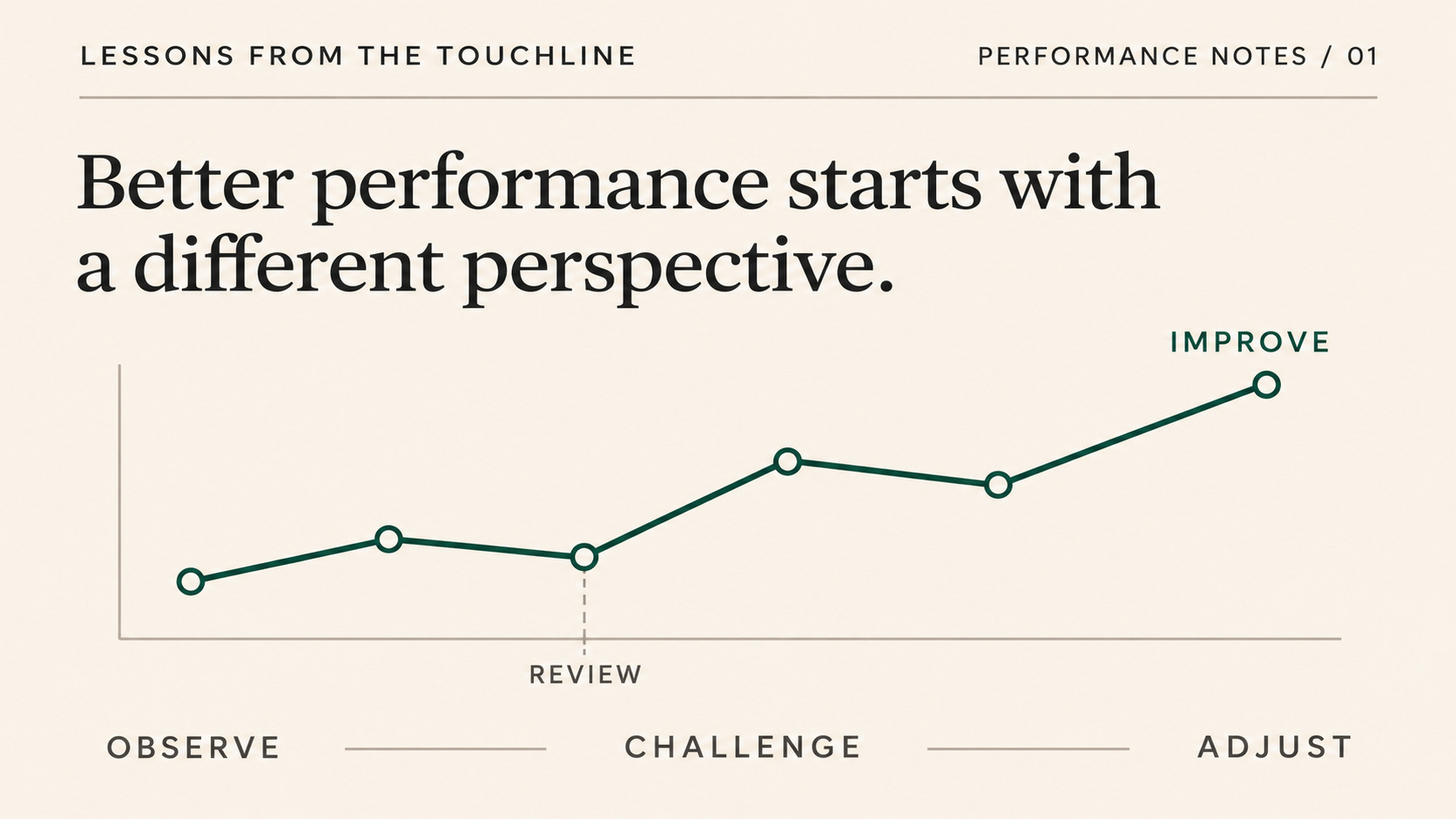
That’s how performance improves: through a repeated process of observation, action and refinement.
You don’t have to wait until something goes wrong
Perhaps the biggest lesson we can borrow from professional sport is that support shouldn’t be reserved for moments of difficulty.
The best athletes don’t work with coaches because they’ve reached the limits of their ability. They work with them because they understand that improvement requires more than talent, determination and experience.
It requires perspective, evidence, appropriate support and a willingness to examine what’s actually happening.
The same applies whether you’re running a business, leading a team, building a career or trying to manage several competing responsibilities.
Being capable doesn’t mean you can see everything clearly. Being experienced doesn’t mean your judgement can’t benefit from being challenged. And being successful doesn’t necessarily mean your current way of working is the best way to continue.
Sometimes the most valuable thing you can do isn’t to add more hours, find more motivation or push yourself harder.
It’s to identify what’s missing from the system around your performance.
And then build it.
Work with me
After more than twenty years inside professional rugby, I now work with high performers (or anyone who wants to start performing on a higher level) who want to examine how they’re operating, identify what’s holding them back and build better systems for the demands they’re facing.
My 1:1 High Performance Coaching provides a dedicated space to think, challenge assumptions and turn that thinking into practical action.
Discussion about this post