What Elite Sport Understands About Getting Better at Your Job
The surprising reason working harder isn’t always the answer and a practical way to identify what’s really holding you back.

Imagine winning a rugby match on Saturday afternoon, celebrating with your teammates, enjoying the applause of thousands of supporters and heading home feeling rather pleased with yourself.
By Monday morning, you’re sitting in a room watching footage of everything you got wrong.
Welcome to professional sport.
Because while the supporters might spend the weekend discussing a fantastic victory, the coaches and performance analysts will already be examining what happened during those 80 minutes. And a win, however convincing, doesn’t necessarily mean everything went well.
There might have been a problem with the defensive structure, a series of poor decisions or opportunities that went begging. Equally, a team that lost might have made significant improvements in areas they’ve been working on.
The scoreboard tells you who won. It doesn’t necessarily tell you who improved.
And that distinction is something I think we could all learn from.
Because most of us approach getting better at our jobs rather differently.
We work harder, stay later, download another productivity app or decide that Monday is the day we’re finally going to become one of those extraordinarily organised people who appear to have their entire lives under control.
I’ve tried that approach myself. It wasn’t particularly successful.
What professional sport taught me was that before you can improve your performance, you need to understand it.
And that’s what I want to show you how to do.

What you’ll learn
Why working harder can sometimes make very little difference to your performance.
How professional sport identifies the things that actually need improving.
A simple three-step approach to finding and closing your own performance gaps.
Let’s get into it.
Why winning doesn’t always mean you’re getting better
One of the most fascinating things about professional rugby is the amount of work that happens when the match has finished.
To the supporter, the result is everything. You’ve either won or lost, and depending on which side you’re supporting, you’re either celebrating over a pint or spending the journey home explaining why the referee was entirely responsible for the outcome.
But inside a professional rugby club, the result is only part of the picture.
Performance analysts spend hours examining footage, identifying patterns and gathering information that coaches can use to prepare the team for the next match.
My husband worked in performance analysis in professional rugby, so I know only too well how much time goes into this process. While everyone else is enjoying their Sunday morning, an analyst may already have spent hours reviewing the previous day’s game.
And what they’re looking for is rather more interesting than whether the team won.
They want to understand why things happened.
Was a particular defensive problem caused by poor communication, positioning or a decision made several phases earlier? Did the opposition exploit a weakness that had already been identified? Was something that worked in training successfully transferred into the match?
The answers matter because they determine what happens next.
Imagine a team that wins comfortably despite repeatedly conceding possession in dangerous areas. The victory is lovely, of course, but that particular weakness could become rather expensive against a stronger opponent the following weekend.
If the coaches simply congratulated everybody and moved on, they’d be missing an opportunity to improve.
Now consider the opposite.
A team loses narrowly but has made significant progress in an area that has caused problems for several weeks.
The result is disappointing, but the improvement is real.
Professional sport has to recognise both.
And this is where I think we often get our own performance completely wrong.
We judge ourselves by the result without spending nearly enough time examining what produced it.
You delivered the presentation, so you must be getting better at presenting.
You had a productive day, so your time management must be improving.
You didn’t achieve your target, so you obviously need to work harder.
But do any of those conclusions actually tell you what happened?
Not really.
The mistake most of us make when we want to improve
I used to be a terrible procrastinator.
And when I say terrible, I mean I could spend an extraordinary amount of time thinking about doing something, discussing doing something and finding other things that apparently needed doing before I could possibly begin the thing I was supposed to be doing.
I was busy, certainly. Whether I was achieving very much was another matter entirely.
Working in rugby changed the way I approached this, partly because professional sport doesn’t give you an awful lot of room to spend three days contemplating your options.
There’s another match coming. Another deadline. Another problem that needs solving.
You have to work out what matters and get on with it.
But the really useful lesson wasn’t simply to become more organised. It was learning to distinguish between the problem I thought I had and the one I actually needed to solve.
Let’s say you’re struggling to get through your workload.
You decide the problem is that you’re not disciplined enough.
So you buy a planner, start getting up earlier and promise yourself that from Monday you’ll be an entirely different person.
Wonderful.
Except, two weeks later, you’re still struggling.
Why?
Perhaps because discipline was never the problem.
Perhaps you’re agreeing to too many commitments, spending half your day responding to other people’s priorities or underestimating how long your work actually takes.
You can become the most disciplined person in the world and still struggle if you’re trying to complete twelve hours of work in an eight-hour day.
And yet we do this to ourselves all the time.
We label ourselves disorganised, unmotivated, indecisive or lacking in confidence, and then attempt to fix those enormous perceived character flaws.
It’s a rather exhausting way to operate.
In professional sport, the aim is to identify the specific performance gap, because that’s what gives you something useful to work on.
You can borrow that approach without having a team of coaches standing behind you with a clipboard.
How to find the performance gap that’s actually holding you back
I want to take you through a simple process that draws on the way I’ve learnt to approach performance.
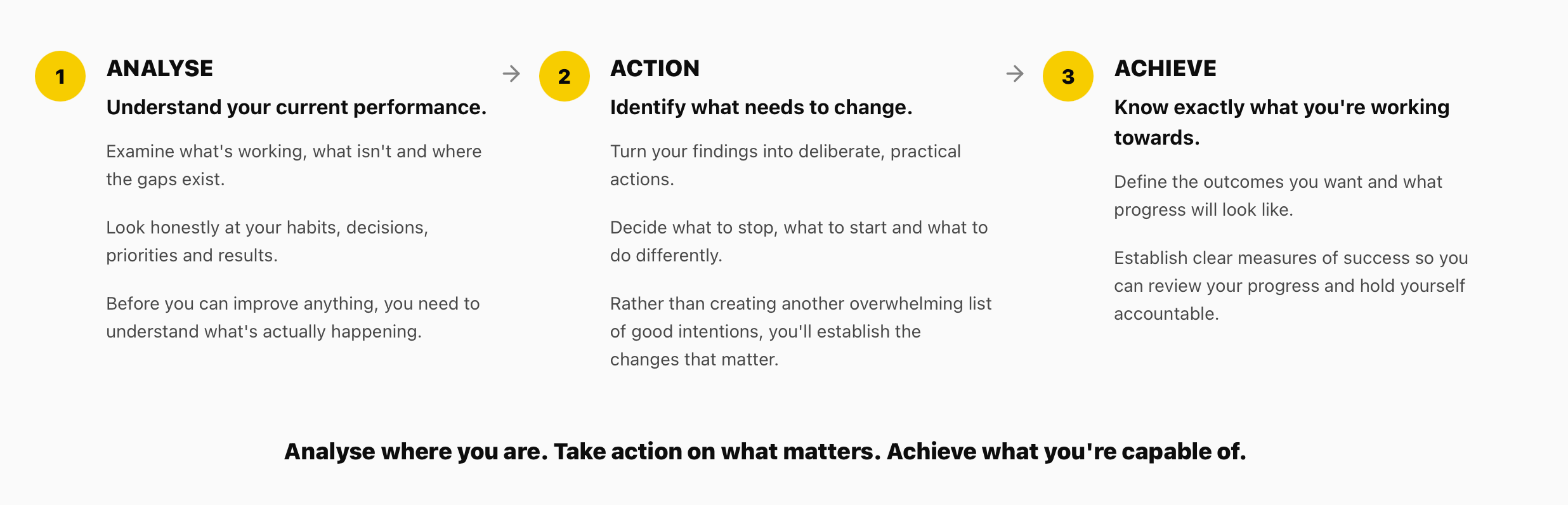
It’s called Analyse, Action, Achieve, or The Three As.
And rather than giving you a list of things to think about and leaving you to work out what to do with them, let’s use an example.
Imagine you’re a capable professional who is constantly busy, frequently working late and becoming increasingly frustrated because the important things never seem to get finished.
You know you’re good at your job. Other people think you’re good at your job. But somehow, despite all the effort, you’re not making the progress you’d like.
Here’s how I’d approach it.
1. ANALYSE: Find out what’s actually happening
Before you change anything, you need to understand what’s going on.
In professional rugby, analysis isn’t simply an exercise in identifying mistakes. It’s about gathering information that helps the team understand its performance.
You can do exactly the same thing.
For the next five working days, pay attention to how you spend your time.
Not how you intend to spend it. How you actually spend it.
Record when you’re interrupted, how long tasks take, which activities consume most of your attention and what gets pushed to the following day.
You don’t need a complicated system. A notebook will do perfectly well.
At the end of the week, look at what you’ve discovered.
Perhaps you realise that you spend the first two hours of every morning responding to emails and messages, leaving the work that requires proper concentration until the afternoon.
Perhaps you discover that you agree to every meeting you’re invited to, whether you need to attend or not.
Or perhaps the real problem is that you’re trying to manage everything in your head, which means you’re constantly worrying about what you’ve forgotten.
Now we’re getting somewhere.
Because instead of concluding that you’re hopelessly disorganised, you’ve identified something specific.
Your performance gap might be the way you’re protecting your time, rather than your ability to work hard.
And that’s a much easier problem to solve.
2. ACTION: Change the thing that’s causing the problem
This is where people often get a little carried away.
Having identified a problem, they decide to overhaul their entire working life.
New morning routine. New diary system. New productivity app. No meetings before lunch. No emails after six. A colour-coded spreadsheet that requires a degree in mathematics to understand.
By Wednesday, they’re exhausted from trying to maintain the new system.
And the original problem is still sitting there, waiting patiently.
Professional sport is a useful reminder that improvement doesn’t always require enormous change.
Sometimes a small adjustment, repeated consistently, makes a significant difference.
So let’s return to our busy professional.
They’ve discovered that the first two hours of their day disappear into emails and requests from other people.
Rather than attempting to change everything, they decide to protect the first 45 minutes of each working day for one important task.
That’s it.
One change.
They choose the task the previous afternoon, so they know exactly what they’re doing when they sit down.
Their email can wait for 45 minutes. The world is unlikely to collapse.
And if their role genuinely requires them to respond immediately to certain requests, they can adapt the arrangement to accommodate that.
The point is to choose an action that addresses the problem they’ve identified, rather than one that simply makes them feel more productive.
More effort isn’t always the answer. Better-directed effort often is.
3. ACHIEVE: Check whether it’s actually working
Here’s the part that people are particularly good at forgetting.
The review.
You’ve identified a problem, made a change and followed your new approach for a couple of weeks.
Now what?
Well, you need to find out whether it helped.
Let’s say our busy professional has protected those 45 minutes each morning for ten working days.
They can now ask themselves a few straightforward questions.
Did I complete more of my important work?
Did I feel more in control of my day?
Was the change realistic to maintain?
What got in the way?
What would I adjust next?
Perhaps the results are encouraging. They’ve finally made progress on a project that had been sitting untouched for weeks.
Brilliant. Keep going.
Perhaps they discover that 45 minutes isn’t enough, or that their mornings are genuinely too unpredictable.
Fine. Adjust the approach.
Or perhaps nothing has changed, which tells them that the real performance gap lies somewhere else.
That’s useful information too.
The important thing is that they’re no longer relying on how productive they feel.
They’re examining what actually happened.
Which brings us rather neatly back to the rugby.
A team doesn’t improve simply because it watches footage of the previous match. It improves when that information influences what happens in training and, ultimately, what happens in the next game.
The review only becomes valuable when you do something with what you’ve learnt.
Why this works better than another burst of motivation
There’s a temptation, particularly at this time of year, to imagine that the answer to every frustration is a completely fresh start.
A new month. A new year. A new version of ourselves.
And I understand the appeal. There’s something rather lovely about a clean diary and the possibility that this time we’ll finally become the people who never forget appointments, always finish their work on time and somehow manage to exercise before breakfast.
But the problem with relying on a fresh start is that it doesn’t necessarily address whatever was making things difficult in the first place.
If you’re overwhelmed because you’ve taken on too much, a new planner won’t magically create more hours in the day.
If you’re struggling to make decisions because you’re frightened of getting something wrong, setting yourself a target of making faster decisions won’t necessarily solve the underlying problem.
And if you’re not progressing because you haven’t been clear about what you’re trying to achieve, working harder could simply mean getting to the wrong destination a little more quickly.
This is why I find the approach used in professional sport so valuable.
It encourages you to examine the reality of your performance rather than making assumptions about yourself.
And once you have that information, you can start making sensible decisions.
You don’t have to wait for a new year or a particularly inspiring Monday morning.
You can begin today.
Try this before the end of the week
I’d encourage you to spend 15 minutes doing the following.
First, identify one thing you’d genuinely like to improve.
It could be your ability to concentrate, manage your workload, make decisions, communicate more confidently or find time for something important.
Next, ask yourself what evidence you have about the problem.
What actually happens? When does it happen? What gets in the way? Are you dealing with the real issue or simply assuming you know what it is?
Finally, choose one small action you can test over the next seven days.
Not a complete life overhaul. One practical change that addresses what you’ve discovered.
Then review it.
If it helps, keep doing it. If it doesn’t, adjust.
You might be surprised by how much you learn about yourself when you stop making assumptions and start paying attention.
And that’s really the point.
Professional sport is full of exceptionally talented people who work incredibly hard, but talent and effort alone don’t guarantee improvement. There has to be a process for understanding what’s happening and deciding what to do next.
We can all learn something from that.
Because whether you’re preparing for an international rugby match, managing a business or simply trying to get to Friday without feeling as though you’ve spent the entire week chasing your own tail, knowing where to direct your effort is a rather useful skill.
And considerably less exhausting than trying to improve absolutely everything at once.
Want to take this a little further?
In professional rugby, performance reviews weren’t simply about identifying what had gone wrong. They were about understanding what was happening, finding the gaps and agreeing what needed to change.
I’ve taken that same approach and made it available through The Three A’s: Analyse · Action · Achieve.
It’s a structured personal performance review that takes you through 27 guided questions covering your Health, Personal and Work performance. You’ll examine what’s working, identify the habits, decisions and priorities that might be holding you back, and create a practical plan for improvement.
And there’s another part to it.
Once you’ve completed your review, I’ll personally examine your answers and send you my written observations and recommendations, drawing on my experience working inside professional rugby.
Because sometimes it’s the things we haven’t noticed about our own performance that make the biggest difference.
Until next time,
Kate
Lessons from the Touchline
Discussion about this post