


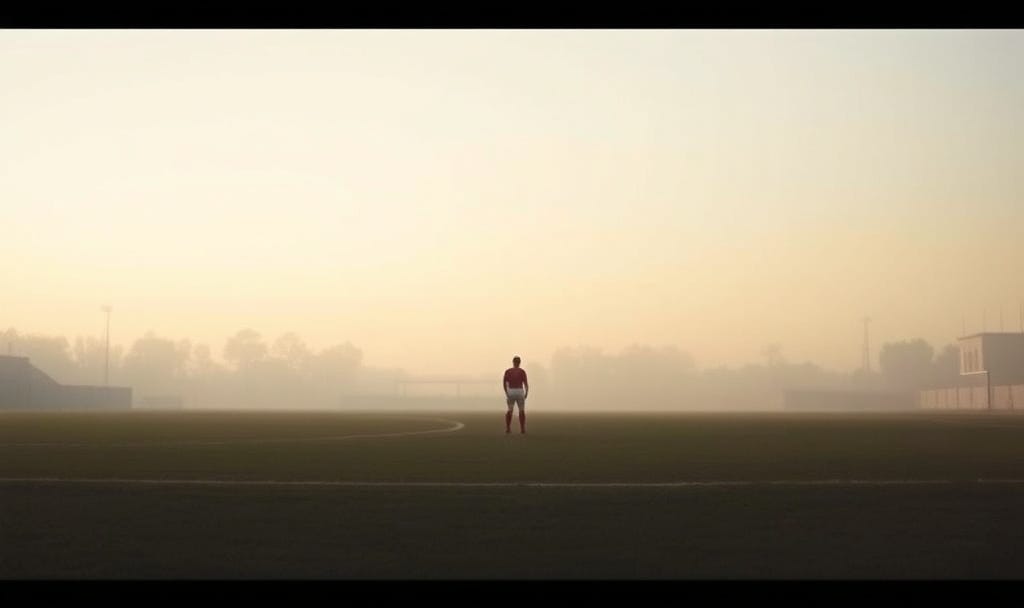
I remember watching a young player who, if you were judging purely on first impressions, probably wouldn’t have been the one you picked out to go on and make it.
He wasn’t the biggest in the group, or the fastest, and he certainly wasn’t the one people were talking about at the time. If you had stood on the side of the pitch and tried to predict who would progress, your attention would likely have gone elsewhere.
But there was something in the way he approached things that stood out quite quickly, and it had very little to do with natural ability.
He didn’t seem to be waiting for reassurance from anyone around him, and he wasn’t looking sideways to see how he compared or where he fitted in. There was no sense that he was adjusting himself depending on who was watching or what the situation required. Instead, he just got on with it in a very steady, unremarkable way.
Session after session, he trained like someone who had already decided that he belonged there, even though there was very little external evidence at that point to support that belief.
What most people would have done
He was often on the edge of selection, sometimes just outside of it, and there were others being picked ahead of him who, at that moment in time, looked like the more obvious choices. It would have been very easy, in that position, for his behaviour to change.
Most people, when things are not going their way, start to hesitate slightly. They begin to second guess what they are doing, or they look for signs from others that they are on the right track. When that reassurance is not there, standards can quietly slip, even if it is only in small ways.
That is usually where things begin to stall.
What he did instead
What stood out about him was that none of that seemed to happen.
There were no big reactions, no visible frustration, and no sense that his standards dropped when things didn’t go his way. He simply kept operating in the same way, regardless of the circumstances around him.
Over time, something began to shift, but it wasn’t particularly dramatic and it didn’t happen overnight. What changed was not him, but how the people around him started to see him.
Coaches began to trust him more, teammates became more comfortable relying on him, and gradually the opportunities that had been just out of reach started to come his way.
It wasn’t because he had suddenly become a different player. It was because he had been operating at a consistent level for long enough that it became difficult to overlook.
What this actually shows
That is one of the more understated parts of professional sport, and it is very easy to miss if you are only looking at outcomes.
Confidence is often talked about as though it is something that arrives first and then allows everything else to follow, but in reality it is very often built in the absence of recognition. It develops when there is no immediate reward for the way you are showing up, and when no one is particularly reinforcing what you are doing.
That is the point at which most people’s behaviour changes.
Without that external validation, it is very easy to hesitate, to second guess decisions, or to pull back slightly and wait for a clearer signal that you are on the right track. And that is usually where things start to stall.
What backing yourself actually looks like
Backing yourself, in that sense, is not particularly loud or visible. It does not look like constant confidence or big moments of certainty. It is much quieter than that.
It shows up in how you choose to operate when there is very little external reason to do so, and in whether you are willing to maintain your standards when it would be easier to let them slip.
I have heard Eric Thomas talk about ‘the dog’, that part of you that keeps things moving when no one else is watching and when there is nothing immediate coming back to you for the way you are approaching it.
It also shows up in whether you are prepared to behave like someone who belongs in a space before anyone has formally decided that you do.
Why this should matter to you
So why does any of this apply to you?
Why pay attention to how things work inside a sporting environment?
Because at that level, people are operating at the top end of their field. In many cases, the top one percent, if not less. The margins are small, and the difference is rarely about ability alone.
It comes down to how they approach things. How they structure their time, how they respond when things are not going their way, and how they maintain standards when there is very little room to hide.
And when you strip it back, those behaviours are not exclusive to sport.
They are transferable.
You don’t need to be in that environment to take something from it. You just need to be willing to look at how you operate, and whether small changes there might have a bigger impact than you expect.
Thanks Kate well said. An important subject. Self-reliance, self-belief, perseverance. Being where your feet are enjoying the experience and opportunity to do your best without fear or any negative thoughts. So important to focus on the process not outcomes or the noise. Rubs off on those around you. Focus is on what really matters which is are you giving your best effort, which is all you truly control.
Great read! During my career, I had to remind myself, and others who asked for my advice, to always bet on yourself. It's such a powerful mindset because even when things aren't going your way, you know it's only a matter of time before they do.
This approach also works very well when making a huge decision. I remember having to decide between two job opportunities. I stressed over the decision for far too long. Finally I remembered the bet on myself approach and quickly realized I would be fine either way. If, over time, I didn't like the choice I made, I knew I'd figure it out.