



Amanda Leachman is a former elite gymnast and CrossFit Games athlete who went on to lead at Partner level in a consulting firm. She now writes about what high achievement actually costs and what it can look like when you do it differently.
When I read Amanda’s work, a lot of it felt familiar. Not because I was an athlete, but because I have spent more than twenty years inside high-performance environments.
This piece explores some of the lessons sport teaches that remain just as valuable in leadership, business and life. If you enjoy the ideas we discuss here at Lessons from the Touchline, I think you’ll find a lot to learn from Amanda too.
There was a season when I would sit in my car in the garage beneath my office until I was ready to lead.
Sometimes that took five minutes. Sometimes thirty.
I was a Partner in a consulting firm, responsible for 150 people, and I had learned something that no leadership training ever taught me: you cannot perform when you’re not ready to take the field.
I learned that as a gymnast at 9 years old.
My name is Amanda Leachman. Kate has generously shared her platform with me to talk about what we carry from sport into the rest of our lives.
I walked into a gym for the first time at four years old and didn’t walk out — not really — for thirteen years. Those years gave me more than athletic skills. They shaped who I became.
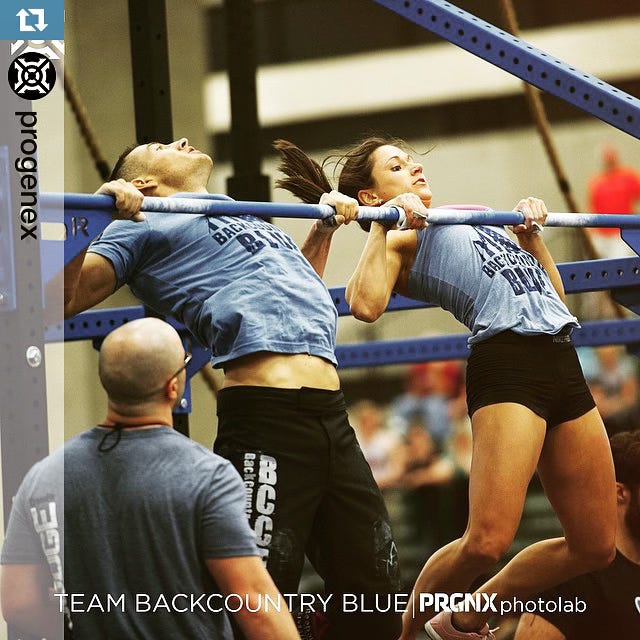
Later, that foundation showed up in CrossFit, where it carried me to the 2016 CrossFit Games. And then it showed up in every boardroom, every hard season, every team I’ve had the privilege of leading.
The environments have been wildly different. The skills have been the same.
These are those skills.
1. Create a vision people can feel.
Athletes know what winning looks like. They’ve imagined it. The vision is so clear that they can feel it in their body long before it ever happens. Because the best coaches are masterful not just at describing the goal but at helping their team fully inhabit it.
That doesn’t happen automatically in the workplace, mostly because roadmaps are changing so rapidly that the finish line is harder to see. But the need is the same. People want to be part of something that matters. They want to feel the direction, not just read it in a slide deck.
You don’t need to be an elite coach to do this, but you do need to slow down enough so that you can actually articulate what you’re asking your team to run toward.
Your energy in describing that vision—whether it be a three-year transformation or a 90-day sprint—will be the difference in how your team experiences it.
2. Build a structure so your team doesn’t have to think about what comes next.
When I was training for the CrossFit Games, every minute of my day was accounted for. Every gram of food was weighed. I didn’t negotiate with myself about whether to show up. The system made the decision. I just executed.
That kind of structure, especially in seasons of intensity, isn’t rigidity. It’s freedom. When you remove the cognitive load of figuring out how to operate, you free people up to do the actual work.
Don’t be afraid to set standards for your team. Build predictable weekly rhythms, create clear communication norms, and hold people to them. Because connection to a vision will ebb and flow with the demands of the day. Structure is what holds it in place when motivation doesn’t.
3. Pay attention to details.
In gymnastics, the difference between a 9.8 and a 10.0 was my pinky toe. I am not exaggerating.
Or when I was competing in CrossFit, we knew the event was won or lost in the smallest moments. We practiced 5-second transitions over and over and over because we knew those seconds added up.
But so often in business, detail is the first casualty. We compress, we summarize, we build a 10,000-ft-view roadmap and hand it to teams to execute, and then we wonder why the big vision never quite materializes.
Leading like an athlete means breaking the vision down to its smallest components and then noticing how those components are executed. If it needs work, refine and do it again. If it’s done well, celebrate it. The small things are in fact the big things, and the small winds can sustain a team through the long middle of a hard season.
4. Lead with humility — the kind that isn’t quiet.
There is no ego on a great sports team. Not the good ones.
The teams that go the furthest are the ones where even the leaders can say they need help because, in sport, pushing beyond an individual red line hurts the entire team.
The same is true when we lead in business. The strongest leaders make quick decisions without being precious about them and backtrack just as fast when they’re wrong. They communicate when they’re running low. They step back in when someone else needs a break.
That’s not softness. It’s knowing that the team’s performance is the point, not the appearance of being the one who’s always right.
5. Know the difference between on the field, in the locker room, and off the clock.
Athletes are performers. There is an on-field version— focused, composed, bringing energy because your team needs it. There is a locker room version — more human, building the trust that performance runs on. And then there is the version that exists when you’ve taken the uniform off entirely.
Sitting in that parking garage was my version of knowing the difference. The cost of walking onto the field before I was ready was too high — not for me, but for the 150 people waiting on the other side of the elevator.
Your energy becomes their energy. You cannot sustain what you don’t replenish. If you’re always on the field, you’ll burn out. If you’re never on it, you’ll lose the room.
6. Learn to channel the noise.
I’ve stood at the edge of a competition floor when the only thing I could hear was my own heartbeat. The crowd fades. Everything goes quiet except that sound in my ears.
I’ve felt the same thing in high-stakes client meetings. Leading through crises. Navigating politics at the executive level. The platform is different. The stakes feel different. But the skill is the same.
Calm is not the absence of pressure. It’s the ability to perform in its presence. Athletes learn this because they will fail if they don’t. The stakes are the same for most leaders, but it’s a skill that’s not often taught.
And one more thing.
Everything above is about how the skills of sport can make us better at leading in all contexts of life. But there’s a similarity between sport and career that is worth naming.
Regardless of the pursuit, when we focus solely on outcomes, we are at constant risk of tying our worth to what we produce.
I left gymnastics with a list of accomplishments and a quiet, persistent sense of failure. Because my identity was built on outcomes I ultimately didn’t control. When I came back to competition through CrossFit and through my rise in my career, I did it with a different relationship to what the result meant about me.
The pressure didn’t disappear, but my worth wasn’t on the line. That not only made it easier to move on when the time came, but it also made it a lot more fun.
You are not what you do. And the counterintuitive truth is that you’ll lead better — compete better, live better — when your worth isn’t riding on the outcome.
Sport taught me that last. It might be the most important lesson of all.
Amanda Leachman writes The Truth About Achievement — a weekly Substack for high achievers who don’t want to quit the arena, they just want to stop losing themselves inside it. Her memoir, Built for More, is forthcoming. Find her here : https://amandaleachman.substack.com/
Performance environments often look different on the surface, but the fundamentals stay the same; clarity, structure, and how well people manage pressure often matter more than raw effort alone.