



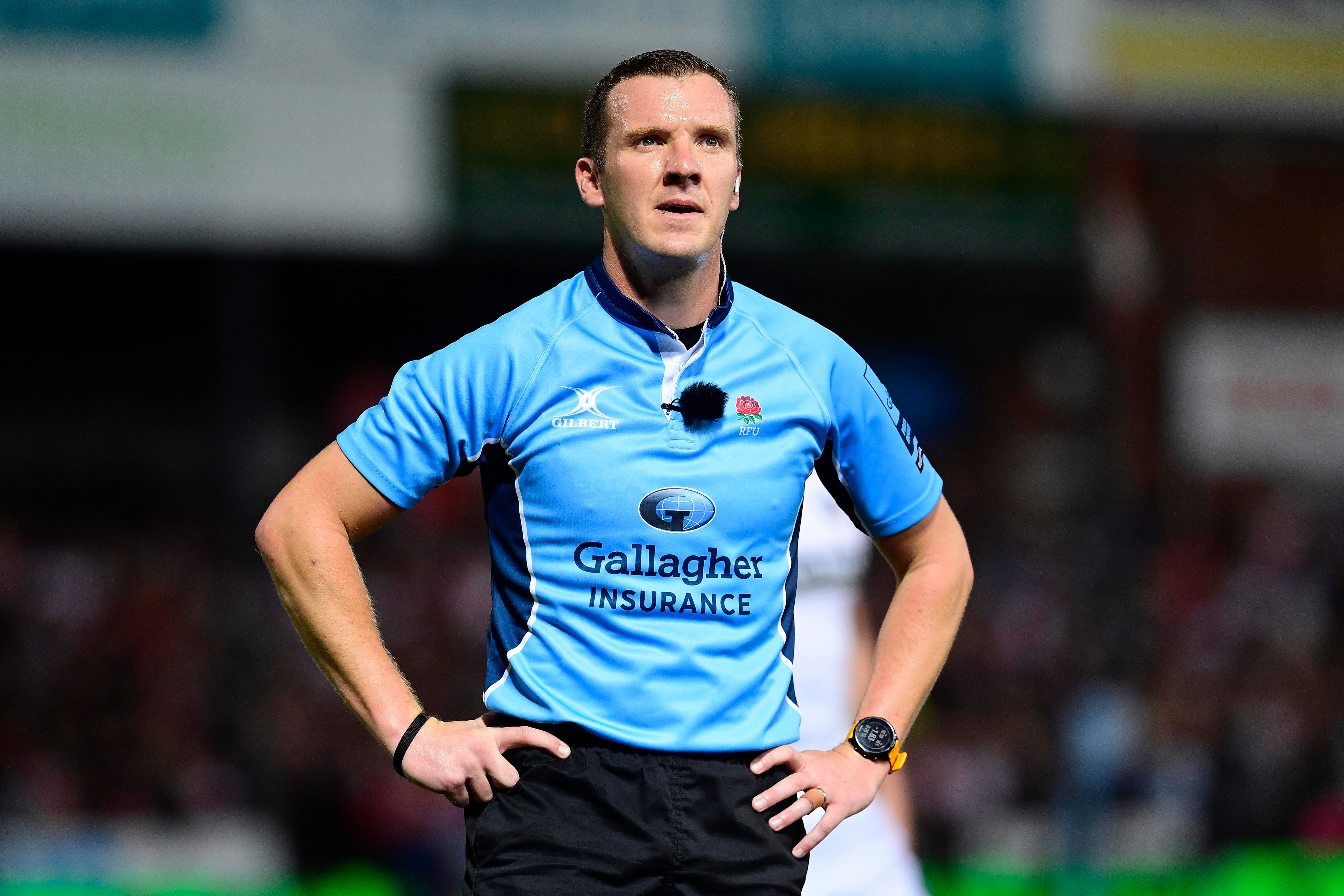
Tom Foley spent more than a decade officiating professional rugby at the highest level, including a World Cup final, making contested, irreversible decisions in seconds, under intense scrutiny, with every word broadcast live.
He now helps boards and leadership teams make hard decisions, surface the truth they need to hear, and hold their nerve under pressure. He writes The Hard Call, on decision-making, legitimacy and composure when there is no right answer.
Tom and I connected after recognising something in each other’s work. Our careers ran adjacently, his inside the game as an official, mine behind the scenes in the media and communications world of professional sport, but the challenges we faced and the lessons we drew from them turned out to be remarkably similar.
This piece is about composure under pressure, and why it is not a personality you are either born with or not. It is a discipline. I think you will find this piece well worth your time.
Recently I sat in a boardroom of a large multinational organisation that was quietly coming apart. Not financially, not yet, but in the way that tends to come first. The brand was under attack, the numbers were sliding, and the pressure had moved out of the spreadsheets and into the bodies of the people at the top. The meetings ran fast and loud. People talked over each other. Decisions were made twice and reversed three times. There was a great deal of emotion and very little control.
What they could not see from the inside was that their panic was not staying in that room. It was cascading. Every clipped email, every plan changed at the last moment, every visibly rattled appearance in front of their own people was being read, copied and amplified one layer down, and then another, until an entire organisation was behaving like a frightened animal because the dozen people at the top were.
I did not tell them to calm down. You cannot order a human being to feel something, and telling a stressed person to relax is the fastest way to make it worse. What I told them was this. It is completely natural to feel the panic. Everyone in this building feels it, and you are not failing because you feel it too. But when the eyes of the organisation are on you, your job is to be the calmest people in the room. Not the calmest people in the world. The calmest people in that room, on purpose, for the few minutes it matters most.
Then we got specific, because “be calm” is useless and the specifics are everything.
Calm is not a temperament
The most damaging belief about composure is that it is a personality. That some people are simply built serene, with slow pulses and even voices, and the rest of us are not, and that is the end of it.
Let me offer myself as evidence against it. For more than a decade I officiated professional rugby at the highest level, making irreversible decisions in seconds, in front of tens of thousands of people in the stadium and millions more at home, with every word I said broadcast live. And I can tell you with certainty: I am not a naturally calm person. When the hardest calls landed on me, my heart rate was not the heart rate of a serene man. The composure I showed was not a feeling I was lucky enough to have. It was a performance I had trained, deliberately, for years, precisely because I knew the feeling would not be there when I needed it.
There is a serious research literature behind this, gathered under the slightly unusual word equanimity. Equanimity is the even-minded, non-reactive state that lets a person meet difficulty without being swept away by it, and two findings about it matter enormously to leaders. The first is that it is consequential: people higher in equanimity regulate their emotions better and perform more steadily under stress. The second, and this is the liberating part, is that it is trainable. There is a degree we are born with, but it is mostly a skill, built through emotion regulation and cognitive flexibility, the way a muscle is built. The Stoics knew this long before the psychologists measured it. We are disturbed, they argued, not so much by events as by the view we take of them, and the view can be trained.
The balance between arousal and control
It helps to be precise about what we are training. Composure is not the absence of pressure. It is a balance, the regulated point between raw arousal and conscious control. At one end is the fully flooded stress response, the racing heart and the tunnel vision, the body acting before the mind can intervene. At the other end is cold detachment, which is its own failure. Psychological balance is holding the dial at the point where you are aroused enough to be sharp and controlled enough to choose.
This is not a metaphor. More than a century ago, Yerkes and Dodson described the relationship between arousal and performance, and it has held up ever since. A little arousal sharpens you. But past an optimal point, rising arousal does not just feel worse, it makes you think worse. Attention narrows. Working memory falters. The capacity for complex problem-solving, the exact capacity a hard decision needs, degrades. An over-aroused leader is cognitively impaired at the precise moment the stakes are highest, and is pulling the whole room’s arousal up with them.
You are the thermostat
Which is why the leader’s balance matters more than anyone else’s. Human beings co-regulate. Our nervous systems are not sealed units; we read each other constantly, below conscious thought, and we tune ourselves to the most central person in the room. In a crisis, the group calibrates to the leader. You are not a thermometer, reading the temperature. You are the thermostat, setting it.
The research turns that from a nice idea into a hard claim. Emotional states transfer between people automatically, as we synchronise with one another’s expressions, voices and postures, which Hatfield and colleagues mapped in detail. At group level, Barsade’s work on the “ripple effect” showed this contagion measurably shifts cooperation, conflict and performance. And Sy, Côté and Saavedra demonstrated the specifically downhill flow: a leader’s mood transfers to the group’s emotional tone and, through it, shapes how the group coordinates and what it decides.
That is exactly what was happening to my boardroom. Their panic was not a personal weakness. It was a contagion event, and they were patient zero. The instruction to be the calmest people in the room worked because it put the lever in the only place it actually sits. They could not calm the organisation directly. They could only regulate themselves and let co-regulation carry it downward, the same channel that had been carrying their fear.
There is a connection here to something I have written about before. Amy Edmondson’s work on psychological safety shows that in low-safety rooms people do not disagree out loud; they go quiet, they nod, and they undermine the decision afterwards. And the thing that drives safety down fastest is often a visibly rattled leader. Frightened people give you the false yes. A composed leader does the reverse: they make it safe to bring the bad news into the room, because the bad news is clearly not going to detonate the person receiving it. Your composure is not vanity. It is the precondition for getting the truth out of the people around you while you can still use it.
How you actually build it
So how is it learned? Not by deciding to feel calm, which never works, but by training the state and the behaviours that produce it.
Start with the things you can control in the moment. Language goes first under adrenaline, so override it: slow the rate, drop the pitch, shorten the sentences, and where you can, pre-script the phrasing for the moments you know will be hot, so you are reaching for prepared words rather than inventing them with a brain that has gone offline. The body is next, and the room reads it before it hears you, so when everything speeds up, slow your body down on purpose. Settle the hands first, then the posture. And use time, which is the most powerful lever of all: take the time the decision needs, not the time the noise demands, and hold the pause with steady body language so it reads as command rather than indecision.
Underneath all of that sits the lever that makes the rest possible. Composure is in large part a trained physiological state, built through breathing, tempo and, above all, rehearsal under load. You do not learn calm in calm conditions. You build it by practising in pressure, so that when the real moment comes your body does not treat it as a novel emergency, because it has been somewhere like it before. It is why match officials train decision-making with the heart rate up and the legs burning, rather than fresh and seated. You are not only training the decision; you are training the state the decision has to be made in. A simple pre-pressure routine, run the same way every time, becomes an anchor that summons the state on demand. And the part people forget: recover afterwards. The leaders who burn out are not the ones who feel the pressure, because everyone feels it. They are the ones who never learned to put it down.
None of this asks you to feel something you do not feel. It asks you to perform a state, deliberately, and to transmit it to everyone reading you. That gap between the state you are in and the state you transmit is not dishonesty. It is the most generous thing you can offer a frightened room, because your composure becomes the platform the rest of them can think from.
My boardroom did not become serene. Serenity was never the goal. They became regulated. They learned to hold the dial between arousal and control, to settle their own bodies so they could settle the organisation’s, and to be, for the minutes when every eye was on them, the calmest people in the room.
That is not a personality some of them happened to have. It is a discipline all of them could build. And so can you.
Want to go further?
This is the heart of a keynote I give to boards and leadership teams, “The Calmest Person in the Room”, on composure as a trainable discipline and on why a team reads its leader’s nervous system before it reads the strategy. I also work directly with executive teams on decision-making and composure under pressure, the same conditions I spent a career in, just without the whistle.
If you think it would help you or your organisation, I would be glad to talk. You can reply directly to this post, subscribe or get in touch at www.the-hard-call.com. And if you found this useful, do share it with someone who is about to walk into a room that needs them to be the calmest person in it.
This is part of a larger argument I keep returning to, that leadership is the work of changing what people do, and that you cannot do it well from a place of panic.
Composure as a trainable state is a useful reminder that how we regulate ourselves under pressure shapes the system around us, including the decisions and behaviors that accumulate into long-term health outcomes like cardiovascular strain.
Composure is a skill that can be honed in by repetitive bouts and seeing & dissecting the patterns how we react instead of responding in every situation and what are the cues underneath this pattern.
If an individual isn't self aware of the reasons for the patterns behind their reactions, it is quite difficult to change them and let the composure & calm state be in the driver seat even while facing tough situations where things feel out of control.
Calmness for sure lets see any situation/circumstance from a broader aperture whereas angst increases the HR and everything can be seen through a foggy lens.