


A couple of years after I joined Bath Rugby, the club was bought by a new Chairman, and with him came a new CEO.
He was very different from the one before. For a start, he had real experience in sport, and more than that, he genuinely cared about people. I remember the first time I met him. We passed each other on the stairs in our slightly chaotic, makeshift offices, and I introduced myself straight away. I asked if we could grab a coffee so I could explain what I did and how I fitted into the organisation.
He agreed immediately, and we set it for the next morning.
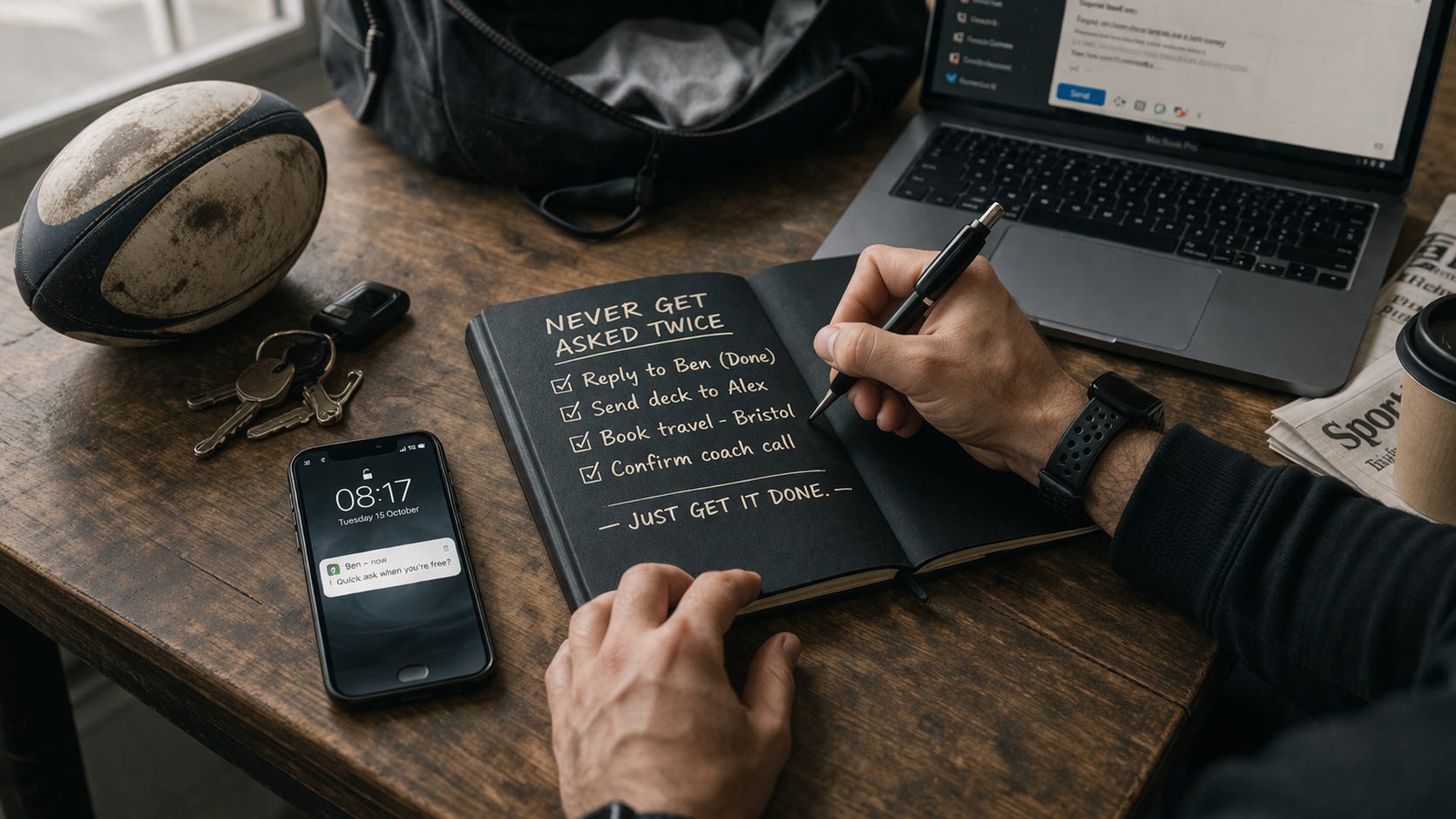
We went across the road to one of the coffee shops in Bath, and when we sat down, he pulled out a small black notepad. I came to learn that this notepad went everywhere with him. He wrote in it constantly, sometimes calmly, sometimes when he was clearly irritated. If he was writing and not smiling, you paid attention.
I talked him through my role, where I thought it could go, what I needed, and where I felt things could be improved. He listened properly. He took notes, asked questions, promised support.
At the time, I had no idea how much of an impact he would have on how I worked, and ultimately, on how I lived. Because he taught me one of the simplest and most powerful standards I have ever come across.
You should never have to be asked twice.
Early on, he introduced management meetings and invited me to join. I remember feeling genuinely pleased about that. For the first time, I felt like I was being seen properly, not just as the press girl, but as someone with a role that mattered.
At those meetings, we were all given actions. I assumed that meant by the next meeting. It didn’t. An action point meant now, or as close to now as possible.
The following morning, he came into my office and asked me about mine. It was something fairly straightforward, a media schedule. I hadn’t done it. I said, quite breezily, that I would get to it, not to worry.
He had other ideas.
I can still picture it. His expression changed almost instantly. His eyes darkened, his face tightened slightly, and the atmosphere in the room shifted. I cannot remember his exact words, but the message was very clear. When he asked me to do something, he expected it done. Not later, not when I got round to it, but now.
I apologised, heart racing slightly, and got on with it immediately. I never made that mistake again.
What I began to understand was that this was never about one task. It was about how you operate.
Because in that environment, everything moved quickly. You had a match every week. Saturday game, Sunday off, Monday straight back in with team announcements, press releases, logistics. By midweek, you were preparing for press conferences, managing players, shaping messaging. By the end of the week, you were in full match mode again.
There was no space for delay and no room for indecision. If something needed doing, it needed doing properly, and it needed doing quickly.
It wasn’t just my role either. The coaches were working to the same rhythm. Review, adjust, plan, execute. The margins were tight, and the timelines even tighter. If you were at the sharp end of the season, preparing for quarter finals or semi finals, you might only have a couple of days to prepare for the next opposition. Decisions had to be made with conviction, without sitting around and overthinking. You learned to trust your judgement, because there was no alternative.
That is where the real shift happened for me. It was about ownership rather than just speed. It meant no waiting to be chased, no sitting on something because you weren’t completely sure. You made the decision, you backed it, and if it needed adjusting later, you adjusted it. But you moved.
That way of operating has stayed with me far beyond sport.
You see it in small things. When we got engaged, we set a wedding date four months later, not because we were rushing, but because we knew what needed to be done and we simply got on with it. We made decisions quickly, trusted them, and moved forward.
The same applies at home. If something needs doing, we do it. We don’t spend weeks circling a decision. We choose, we act, and if it needs changing, we change it.
It applies even more at work. I plan my days. I write things down. I decide what matters and I get on with it. I remove distractions where I can, and I come back to what needs to be done. Not perfectly, but consistently.
He taught me something else too. If you went to him with a problem, that alone was never enough. He didn’t want to hear what was wrong. He wanted to know what you were going to do about it.
That changed how I approached everything. Instead of saying “this isn’t working”, I would go to him with “this is what isn’t working, and this is what I propose we do about it.” It is a small shift, but it changes how you are seen, because you are no longer adding to the problem. You are moving things forward.
Looking back, the lesson was never really about speed. It was about trust. When someone knows they don’t have to chase you, remind you, or check in on you, everything changes. You become easier to work with, more reliable, more valuable. And that is what creates opportunity.
If someone has to ask you twice, you have already taken too long. That isn’t about rushing everything for the sake of it. It is about how you operate. Do you move? Do you take ownership? Do you back yourself? Or do you wait?
This isn’t about being impulsive. It is about being decisive, because in most situations your first instinct is far more capable than you give it credit for. Even if it isn’t perfect, you can adjust. But you cannot build anything if you are constantly hesitating.
Never get asked twice.
It sounds simple. But it changes everything.
Never get asked twice is a benchmark/standard one must set for themselves because then it shows that the other person is seen & their presence is also felt. If one is present there but they feel like they are not seen, it is quite a nasty feeling to have for oneself and the organization they are working in.
Early in my career, I remember going into a meeting with a senior leader where I showed up with a problem but no solution. He expected me to propose a few options on how to address it. The meeting was short, and I never made that mistake again. Tough lesson, but a valuable one.
One small habit I’ve tried to stick to in my personal life is the five-minute rule. If something needs to get done and will take less than five minutes, I do it right away. It seems like a small thing, but it’s amazing how many five-minute tasks there are and how quickly they add up if left undone.