


I’ve lost count of how many times someone has said to me: “I don’t know how you do it.”
And every time, I think the same thing.
It’s not because I’m naturally more confident, or more disciplined, or wired differently.
It’s because of what I spent twenty years watching.


I wasn’t the athlete. I was the person in the background — season after season — with a front row seat to what actually makes elite performers different.
And what I saw, over and over, was that the best in the world weren’t exceptional because they felt confident every day.
They had a system.
A way of thinking, preparing and responding that worked regardless of how they felt.
That fascinated me. And for almost two years I have been working out how to translate everything I observed into something genuinely teachable.
Not just for professional athletes.
For anyone who knows they are capable of more and wants the structure to prove it.
What follows are the five things that sit at the heart of all of it.
Each one is something I watched elite performers do consistently. Each one is something I have now built into a tool, a framework or a programme that you can work through yourself.
None of it requires a sporting background.
All of it works because it is about human performance, not sporting performance.
1. Self belief is not a feeling. It is a standard you set for yourself.
Inside professional sport, the performers who sustained belief over a long season were not the ones who felt it most naturally.
They were the ones who had decided, specifically, who they were as a performer.
They had named it. Written it down. Returned to it when pressure arrived and tried to tell them something different.
Most people treat self belief as something that either shows up or it doesn’t.
In reality, it is something you build deliberately — by getting honest about what is currently getting in the way, by defining who you are when you are at your best, and by setting a standard that does not move when things get hard.
I built the Self Belief Reset for exactly this.
It is a free workbook that takes you through that process — not as a motivational exercise, but as a practical one.
If you have ever felt stuck between knowing what you are capable of and actually backing yourself, that is where to start.
(It is FREE!)
2. You cannot perform well inside chaos. The first job is always to remove the noise.
Before any high performance environment begins a new cycle, the first thing it does is cut.
It removes what is irrelevant, defines what matters most and builds a foundation of focus before any execution begins.
This is not optional. It is the starting point for everything else.
Outside sport, most people skip this entirely.
They move from one week to the next carrying the same noise, the same vague priorities and the same unresolved questions about what they are actually working towards.
Then wonder why progress feels slow.
Getting clear is not a passive process. It means defining who you are performing for and what you are working towards — not in abstract terms, but in specific ones you can return to every single week.
It means being honest about what is currently taking your attention that has no business doing so.
Build the foundation once. Let everything else sit on top of it.
3. Motivation is unreliable. Identity is not.
The shift I saw most consistently in elite performers was this.
At some point, they stopped performing to prove something and started performing because of who they had decided they were.
The behaviour stopped being driven by how they felt on a given day.
It was driven by a standard they had set for themselves that they were no longer willing to drop below.
This is the difference between motivated and disciplined.
Motivated means you act when you feel like it. Disciplined means you act because you have decided that is who you are.
One is dependent on circumstances. The other is not.
Raising your standard is not about pressure or perfectionism.
It is about deciding, clearly and specifically, what you are no longer willing to accept from yourself — and then holding that, especially on the days when it would be easier not to.
4. Knowing what to do is not the same as doing it. The gap between the two is where most performance is lost.
In elite sport, execution is treated as a skill in its own right.
Not a given. Not a personality trait. A trained capacity that gets built through specific habits, routines and systems designed to reduce friction between intention and action.
Most people have more than enough knowledge to perform better than they currently are.
What they are missing is the bridge between knowing and doing.
That bridge is built from small structural decisions: what you do first, what you remove, what you make automatic so that it no longer requires a decision at all.
The question to ask is not “why can’t I follow through?”
It is “what is creating friction between the intention and the action?”
Find that. Remove it. The follow through becomes significantly easier.
That is what elite environments do. It is what you can do too.
5. The performers who improve fastest are the ones who review honestly and consistently.
In professional sport, review is not a luxury.
It is a non-negotiable part of every performance cycle.
After every game, every training block, every week, the same questions get asked: what worked, what didn’t, what needs to change. Not emotionally. Practically.
Most people never do this at all.
They move from week to week on instinct, repeating what felt good and avoiding what didn’t, without ever sitting down to look clearly at how they are actually operating.
As a result, the same patterns repeat. The same friction points keep showing up. The same gap between intention and output persists.
The Three A’s is the review framework I use across everything I do.
Analyse, Action, Achieve.
It is the same weekly cycle that professional teams run, applied to your work, your health and your personal performance.
It gives you a structured way to look honestly at what is happening, decide what needs to change and define what a good week actually looks like.
You can access it as a standalone tool right now.
Find The Three A’s here.
If you want all five, built into a single system, with me alongside you every week
Everything above — self belief, focus, identity, execution and review — sits inside The Performance System
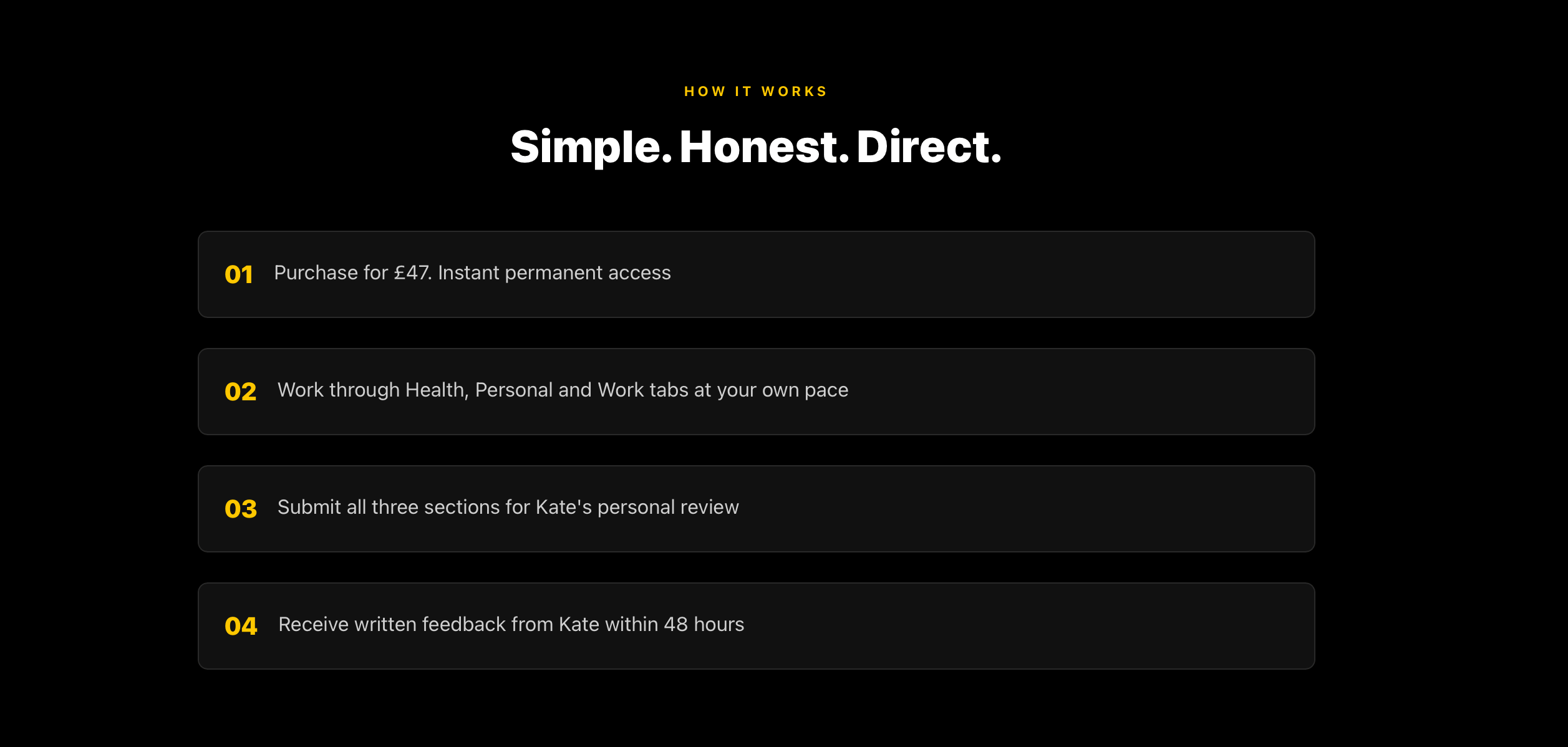
It is a five week programme that takes each of these principles and installs them properly.
Structured weekly work. Practical tools built specifically around you. Personal written feedback from me on every review you submit.
This is not a course. There are no videos to watch passively and forget.
It is structured work, done by you, reviewed by me, built around your life and what you are actually trying to achieve.
By the end of five weeks you will have a Performance Charter — a personal operating system that is yours permanently.
I have tested these principles with people across the UK, Australia and America who have never set foot on a professional sports pitch.
They work because they are about human performance, not sporting performance.
You don’t have to be an athlete to operate like one.