


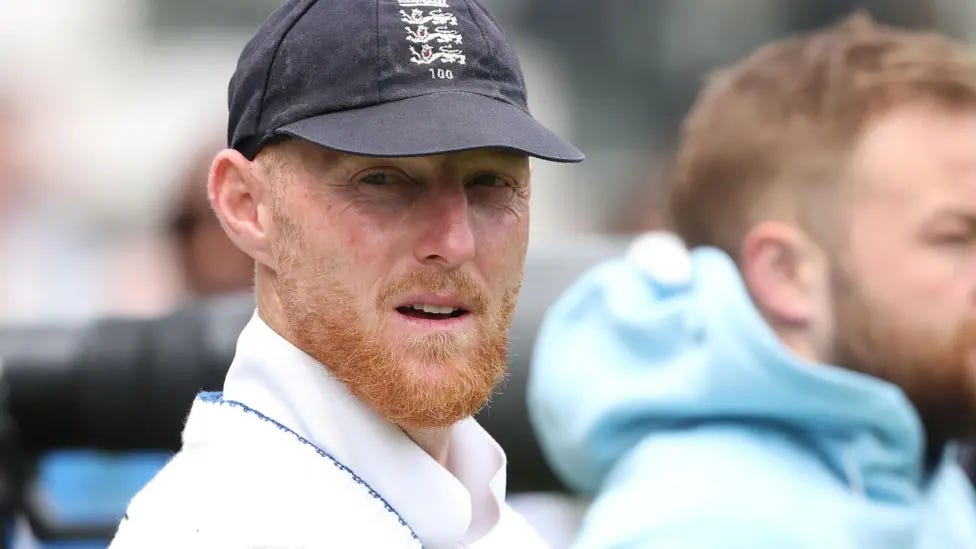
By now, you’ve probably heard about Ben Stokes.
England’s Test captain — one of cricket’s most celebrated figures, a man who has spent years rebuilding his own reputation and transforming the culture of the England team — was out past a team curfew in a Chelsea nightclub in the early hours of Monday morning. He and fast bowler Gus Atkinson were the only two players there after midnight, following England’s first Test win over New Zealand at Lord’s. A fracas ensued involving Totoa Auvaa, a 21-year-old Saracens academy rugby player who had been out with his club celebrating the end of their season. England’s team security officer ended up needing stitches.
As I write this, Stokes's Test future hangs in the balance. He and Atkinson have already been left out of England's squad for the second Test against New Zealand, which starts at The Oval on Wednesday - with Joe Root stepping in as interim captain. The ECB and the Cricket Regulator are still investigating, and what happens next is genuinely unresolved. Auvaa, who has captained Samoa U20 and Samoa A, now has his name attached to a story that has nothing to do with what he can do on a rugby pitch.
Two sports. Two clubs. One incident. And a question that I keep coming back to, because I’ve seen this play out before, from the inside.
At what point do elite athletes forget that they are never just themselves?
I spent twenty years working in professional sport. Not as an athlete — behind the scenes, in the press office, on the road, on the planes, in the hotels. I was one of the people who picked up the phone when things went wrong. And things went wrong more than the public ever knew.
In my time at Bath Rugby, I dealt with a cocaine positive test that became front-page news, drug allegations that consumed an entire off-season, a player door-stepped by journalists outside his home, a tabloid journalist who rang me every fifteen minutes for three hours trying to goad me into saying something I’d regret. I sat in a stadium clubhouse watching a Sky Sports interview/announcement from a player happen in real time that the club hadn’t been told about, with my phone battery dying from the volume of incoming calls.
Every single one of those situations started the same way. Someone made a decision — in a bar, at a party, in a moment of feeling invincible — without accounting for the fact that their individual decision was never really individual at all.
That is what nobody ever seems to say out loud. And it’s what I want to say now.
When you sign for a professional sports team, you stop being just you.
You become part of something that other people have staked their livelihoods on. The coaches, the analysts, the medical staff, the press officers, the commercial team, the community programmes. The other players who train alongside you every day. The fans who have bought season tickets. The young players coming through the academy who are watching your every move because you are what they are trying to become.
None of that disappears when the match finishes and you walk out of the ground.
In my experience — and I say this having watched it happen repeatedly — the athletes who genuinely understood this were the ones who had the longest, most respected careers. Not necessarily the most talented. Not the most decorated. The ones who understood what the badge on their shirt meant at 2am on a Monday morning just as much as it did at 3pm on a Saturday afternoon.
The ones who didn’t understand it? I watched them cause enormous damage. Not just to themselves — to the people around them, to the clubs they played for, to team-mates whose careers were tangled up in stories they had nothing to do with. And to young players like Totoa Auvaa, whose name is now in every cricket and rugby headline in the country through what appears to be nothing more than being in the same building.
There’s something specific about this Stokes story that deserves to be said carefully.
This is not his first nightclub incident. In 2017, there was Bristol. He was arrested, charged with affray, eventually acquitted — but the fallout was enormous, the story was everywhere for months, and he missed the Ashes tour that year. The version of Ben Stokes who has led England since — the Bazball Stokes, the World Cup Stokes, the man who seemed to have genuinely rebuilt himself and his relationship with the game — appeared to understand all of that. Which is why this week feels so jarring to so many people who had invested in that story.
I’m not here to judge what happened at Rex Rooms. I wasn’t there. The investigation will run its course. But I am interested in the pattern. And the pattern tells us something important about the culture we build — or fail to build — around elite athletes.
Because the question isn’t just what Stokes did. The question is: what environment creates the conditions where this keeps happening?
In sport, the standard you walk past is the standard you accept.
That phrase got used a lot during my time in the game — usually by coaches talking about on-field performance. But it applies just as much, if not more, to the culture that exists around the pitch. Who’s enforcing it? Who’s noticing when a player is making decisions that suggest they’ve stopped thinking about the consequences? Who’s having the honest conversation early enough that it doesn’t end up in a courtroom, or on the front page of a tabloid, or in an ECB investigation?
The answer, in my experience, is almost never the person at the top of the food chain.
I remember presenting a crisis management system to a group of club press officers after we’d navigated a particularly brutal off-season. One of the things I said then, and believe now, is that reputation management in sport can never just be reactive. By the time you’re issuing a holding statement and fielding calls every fifteen minutes, you’ve already lost control of the narrative. The work has to happen before the crisis. It has to be baked into the culture of the club from the top down.
What does that look like? It looks like the captains and senior players taking genuine ownership of what the badge means — not just in pre-season media training, but in the actual daily decisions they make and the ones they influence in others. It looks like the structures around athletes giving them honest counsel, not just access management. It looks like building an environment where someone can pull a player aside before the curfew gets broken, not after.
That kind of culture is rare. And when it’s missing, the incidents happen. They always happen.
I want to come back to the academy player in all of this.
Totoa Auvaa is 21 years old. He’s an academy player at Saracens — he hasn’t yet played for their senior team. He captained Samoa’s youth sides. By all accounts he was out with his club on a normal end-of-season night. His name is now attached to an international incident that has put England’s Test captain’s future in jeopardy.
I’ve seen this too. I’ve watched junior players and support staff get swept up in stories that weren’t theirs, because they happened to be in proximity to someone whose decision-making had consequences that rippled outward. They didn’t choose the headline. They just happened to be in the room.
Sport doesn’t protect those people. It very rarely even acknowledges them. The story is always about the star, the captain, the player with the column inches. The collateral damage happens quietly, and it matters.
I believe in Ben Stokes. I believe in the version of him that walked his team through the Headingley miracle and changed the temperature of Test cricket. But believing in someone doesn’t mean suspending accountability — for him, or for the culture that has allowed this pattern to repeat.
Elite sport is built on standards. On the idea that what you do when no one is watching is just as important as what you do when 30,000 people are in the stands. That’s not a slogan. It’s the actual mechanism by which high-performing teams work. When it breaks down, it doesn’t just break down for the individual — it breaks down for everyone who shares the badge.
This week, a lot of people will write about what Ben Stokes should or shouldn’t have done. I’m less interested in the verdict than the lesson. Because in my experience, these stories are never really about one person and one night. They’re about what a culture has decided to allow, to ignore, to normalise — for years before the headline appears.
The scoreboard is the last thing that changes. The culture was always going first.
If this struck a chord, I'd love to know. Hit reply or leave a comment.