


Someone asked me this week how I got into sport in the first place.
It’s a question I have been asked before, but I don’t think I have ever properly answered it. Probably not honestly, anyway.
The short answer is that I fell into it sideways, through a series of moments that I didn’t plan and couldn’t have engineered if I’d tried. The longer answer involves my dad, a rugby match at Twickenham, a stranger by a pool in Italy, a polo ball I nearly didn’t go to, and a freezing cold night in Newbury where I got the job that changed everything.
But let me start at the beginning.
I left university with a First in English and Drama and grand designs on becoming an actress or a journalist. Neither of those things happened, largely because I didn’t want to sleep on sofas waiting for auditions, and my dad made it fairly clear he wasn’t funding drama school. Which, looking back, was probably the right call for everyone involved.
So instead I found myself marketing a Management Diploma for a university, slowly watching my soul leave my body from behind a desk, instant messaging my friend across the office just to stay sane.
I knew I was made for more than that. I just didn’t know what more looked like yet.
Then came Bob Jones.
My dad took me for lunch with him when I was in my early twenties. Bob ran a multi-million pound PR agency and he’d started it all after reading a book about how to run a PR agency. No formal qualifications. No years of experience. Just a book, a belief in himself and a willingness to start.
That lunch changed how I thought about everything.
I had always assumed you needed certificates and credentials and proof on paper before anyone would take you seriously. Bob dismantled that idea completely. What you actually needed, he told me, was belief, drive and gumption. I didn’t know what my version of that looked like yet, but I started paying attention differently after that.
The moment I actually knew came at Twickenham.
My dad had taken my sister and me to watch England play Australia. He’d been doing this since we were young teenagers — he was MD of a company that sponsored a local rugby club, which meant good seats, which meant we went. Most of the time, if I’m honest, I wasn’t that invested in the rugby itself. I was invested in spending time with my dad.
But on this particular afternoon, England scored a try and the crowd went completely wild.
We all leapt to our feet. My dad put his arm around my shoulders, I put mine around his waist, and we jumped up and down together in utter joy. And in that moment, with 80,000 people losing their minds around us, a voice in my head said very clearly:
I want to do this.
I didn’t mean to play rugby. I meant the keys to that moment. The electricity of it. The thing that makes complete strangers put their arms around each other and jump up and down in the rain.
I didn’t have a plan. I didn’t have contacts or experience or a clue how you actually got a job in professional sport. But I had a fire in my belly that told me anything other than this wasn’t going to be acceptable.
My dad had taught me that, his whole life. He wasn’t the kind of father who threw balls in the garden or stood on the touchline at school sports day — if I’m honest, there were times I would have swapped the international matches just for a bit more of the ordinary, everyday version of him. But those big occasions, the Twickenham afternoons, the crowds, the electricity of it all, were his way of showing me the world and what it could hold.
Why not, not why should I?
He said it about life. About opportunity. About the instinct to reach for things rather than talk yourself out of them. It wasn’t always comfortable — there was a time, years later, when I had to turn down a job at the Rugby World Cup in New Zealand and work in South Africa in the same week, and he rang me almost immediately to ask why on earth I wasn’t going. I was early pregnant and barely functioning, but that barely registered as a barrier to him. The opportunities were always more visible to my dad than the obstacles, and part of me loved him for it, even when I wanted to throw the phone across the room.
And without those moments, without that philosophy drilled into me from the stands at Twickenham and a hundred conversations I didn’t always want to have, I genuinely don’t know where my life would have led.
Because the answer to that question, it turns out, is everything. Sport gave me a career I loved, a sense of who I was and what I was capable of, and — perhaps most importantly of all — it gave me my husband, who I met at Bath Rugby and who I am fairly confident is the best thing that ever came out of a lost end of season match. We now have two children who I would run through a thousand walls for, which feels like the most unexpected and wonderful result of that voice at Twickenham saying I want to do this.
I just hadn’t anticipated quite how much doing this would give me back
From the Twickenham moment, I did what I now recognise as the thing that changes everything: I started telling everyone what I wanted.
Loudly. Repeatedly. To anyone who would stand still long enough to listen.
I volunteered to help a friend who was trying to break into women’s motorsport, writing letters to sponsors and newspapers on her behalf and building a portfolio from absolutely nothing. She gave me a book about sports marketing and sponsorship, which I devoured. I found a GB Pentathlete through a sports network and offered to help with his marketing in exchange for dinner and the occasional bottle of wine. I joined a polo club specifically to meet people, then didn’t watch a single polo match all year — which, in hindsight, was quite an efficient approach to networking.
Then there was the holiday in Italy.
I was sitting by the pool when I got chatting to a lovely couple, and did what I always did at that point — told them exactly what I wanted to do with my life. The man looked at me and said, almost casually, “my best mate runs his own sports agency, let me give you his email.” I emailed him the moment I landed back in England. He wrote back to say he had nothing for me at the time, that there was no scope to take anyone on, but he encouraged me to keep going and not give up. Whether he meant it sincerely or was simply being polite, I chose to take it as genuine, and it bolstered my resolve more than he will ever know.
I should also mention that I later met the author of that sports marketing book — the one my racing driver friend had given me — completely by chance, in a shopping mall in Cape Town, South Africa. The world, it turns out, is considerably smaller than it appears from behind a university marketing desk.
Meanwhile, I cornered a player from Newbury RFC in the gym — the poor man was trying to get his weight sets in — told him what I wanted, and walked away with an introduction to their Head Coach. I organised events, wrote press releases, contacted local journalists and worked with their sponsors, all for free, because I understood that experience was the currency I didn’t yet have.
And then came the polo ball.
My friend dropped out at the last minute and I nearly didn’t go. A voice inside me said I had to, so I rang her, told her to throw on a black dress and get over to mine, and off we went, sticking out like sore thumbs among people who had probably been pressing divots together every weekend since childhood. But we found our people — a group of equally random strangers — and one of them, Chris, worked at Swindon Town FC. Within a week, he had told me the Bath Rugby press officer was leaving and that I should get in touch.
I had coffee with her. She suggested I come to a pre-season friendly between Bath and Newbury a few days later and meet the CEO during the match.
It was pouring with rain. It was dark. I was brewing the cold of all colds. I stood on a balcony in Newbury and had a five-minute conversation with a man who asked me if I understood rugby and if I could write match reports.
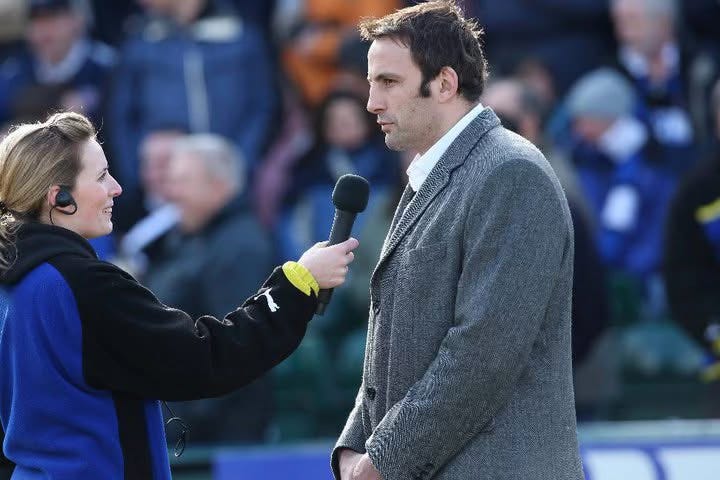
I said yes to both. I understood rugby mostly, and I had never written a match report in my life, but I went home that night and wrote one anyway — just to prove to myself that I could — and a couple of weeks later I started at Bath Rugby. My baptism of fire, as it turned out, was exactly that.
So did I choose sport, or did sport choose me?
After decades of reflection, I think sport chose the version of me that was already there — the one my dad had been quietly building since he first took me to Twickenham. The one who believed, somewhere underneath all the uncertainty, that the answer to most things was why not, not why should I. The one who would write letters to sponsors for free, corner people in gyms, fly home from Italy and email a stranger the same day, and turn up alone to a polo ball just because something inside her said she had to.
I just needed the right moment to hear the voice clearly enough to act on it. And, if I'm honest, she's the person I still have to remind myself I am sometimes.
The Lesson from the Touchline
I have come to believe that some things in life don’t arrive as a logical decision. They arrive as a feeling — persistent, inconvenient, completely irrational to everyone around you — and they simply refuse to go away no matter how sensible you try to be about it.
Sport called to me at Twickenham and I couldn’t unhear it. I had no qualifications for it, no contacts, no clear path and no guarantee that any of it would work. What I had was the absolute certainty that I had to try, and a father who had spent my whole life telling me that why not was always a better question than why should I.
The grit that followed wasn’t glamorous. It was years of free work, unanswered emails, lucky meetings in unlikely places and the stubborn refusal to accept that the answer was no. It looked, from the outside, like someone who didn’t know when to quit. From the inside, it felt like the only option available.
So if something is calling to you right now — a direction, a change, a version of your life that keeps reappearing no matter how many times you push it away — perhaps the question worth sitting with isn’t whether you are qualified for it, or ready for it, or whether the timing is right.
Perhaps the only question worth asking is the one my dad taught me.
Why not?
Kate - this is utterly brilliant.
My daughter is about to leave Newcastle Uni with a good ( 🤞 ) History degree, a great work ethic , a flair for writing and fire in her belly. But she doesn’t know what she wants to do.
I think I’ll send this to her, as an inspiration to follow her dreams.
The last 2 words Why Not struck a chord as this is the same thing Rachel Entrekin was telling to herself while she was leading the Cocodona 250 race outright. All of life's game is about perspective. We can almost re frame things in every situation and positive connotation can be attributed to any situation/place/circumstance instead of labeling it in a negative manner.
One needs to keep a broadened aperture/outlook for life. Then only the opportunities can be seen which we can't see from the place we are in. A narrower approach skews the opportunity pipeline for any individual in any domain/walk of life.